The devices
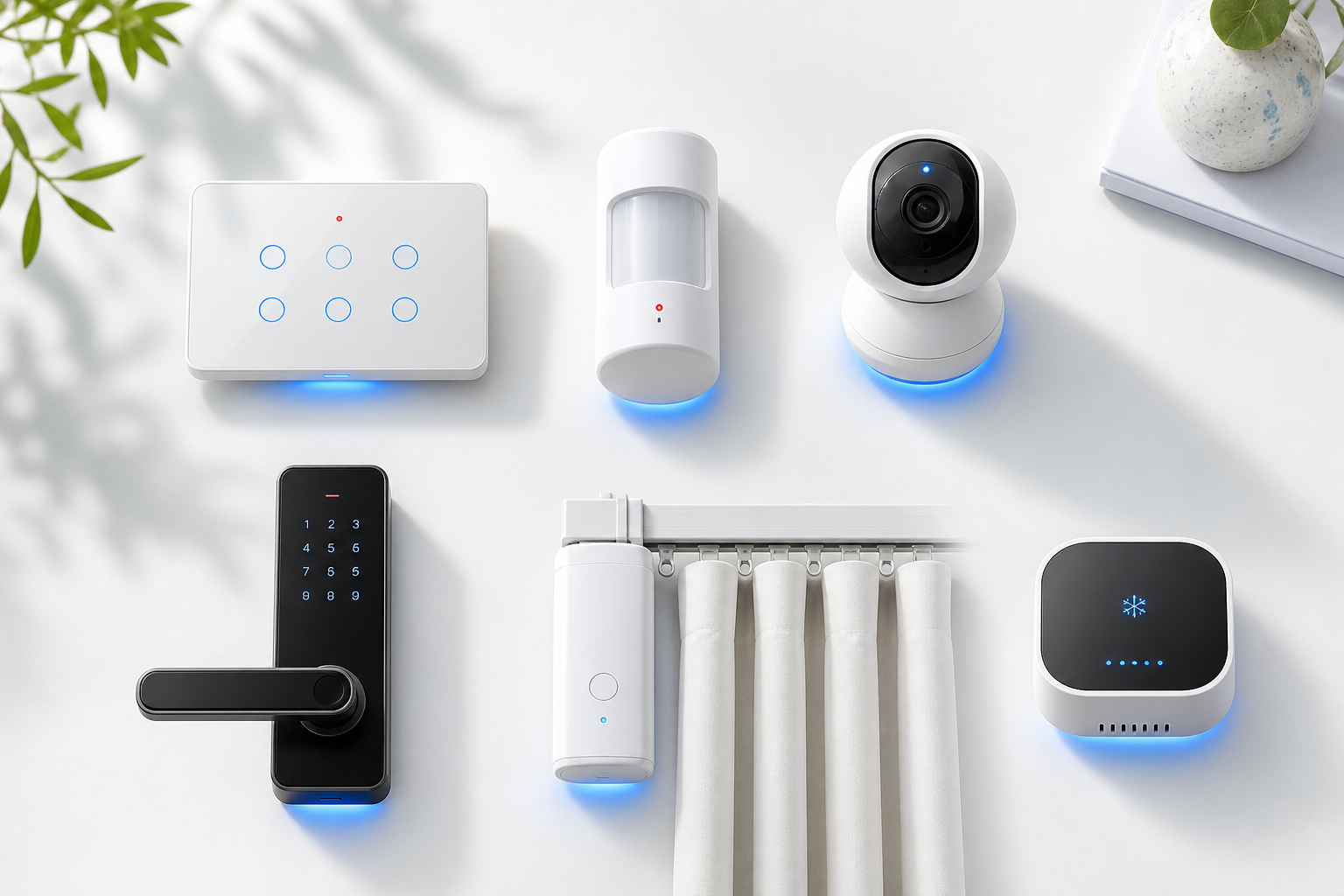
Switches, sensors, cameras, locks, gates, curtains, ACs. What each one does.
Walk into any house and count the things that could listen. That is the whole trade.
A ₹50,000 smart home has about 20 devices. A villa can carry hundreds. At Onwords you will sell them, install them, or rescue them. Learn to name each one in a single line and you will never freeze on a site visit.
The map of one home
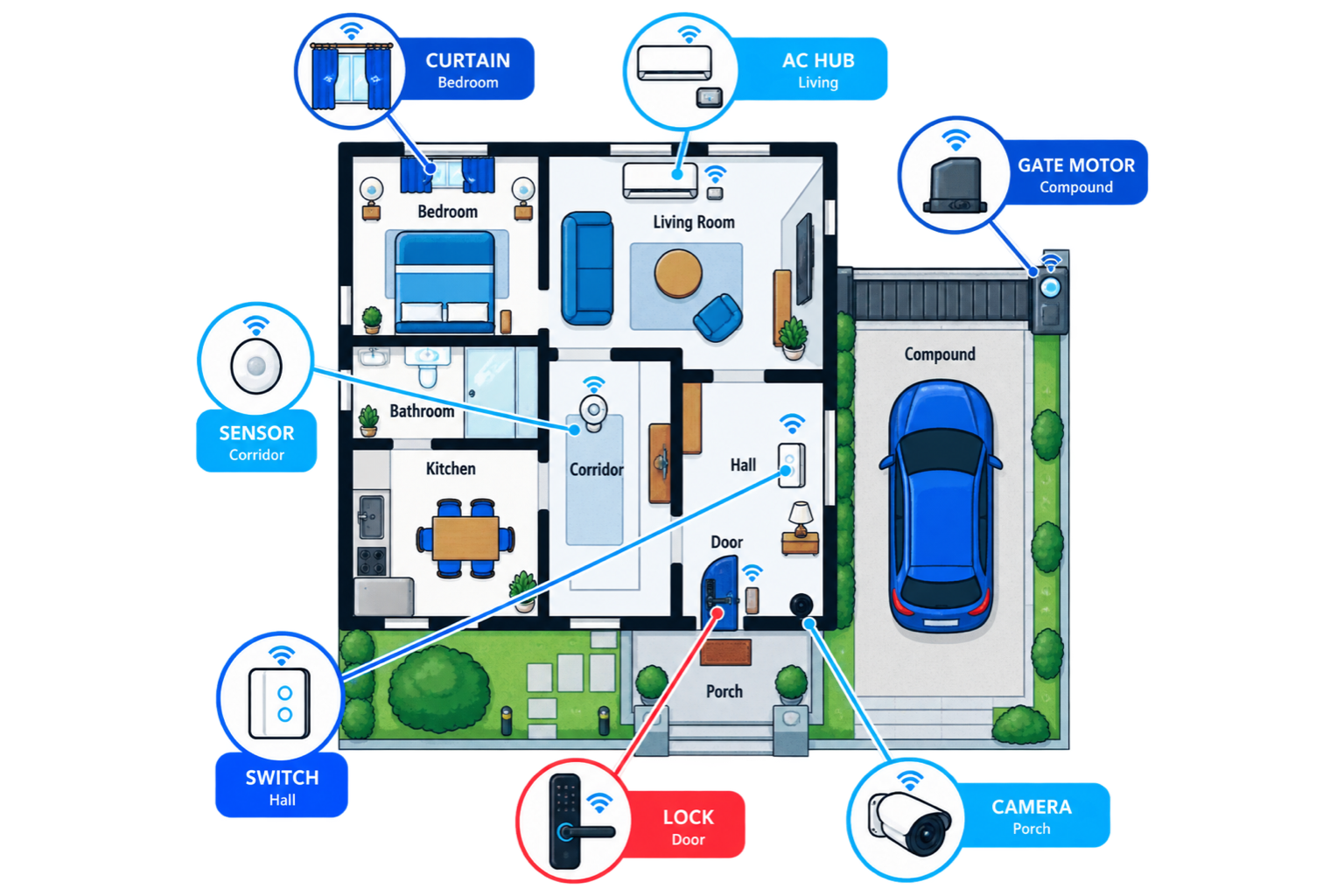
Stand at the gate. Walk in slowly. Every room has a job, and every job can have a device.
The gate is the first hello. The switchboard is the hand. Sensors are the eyes and ears. Cameras watch the compound. The lock holds the door. Curtains meet the sun. The AC holds the room.
Switches
A smart switch looks like a normal plate, and you can still press it with a finger. That matters: the wall switch always wins.
Behind the plate sits a small module that also listens to the app, to a scene, to a schedule. "Good night" can kill ten lights in one breath.
We build our own relay modules and touch plates. On real sites you will meet our 3-channel boards and 3+1 touch controllers.
And fans. India runs on fans. We built a true 5-speed smart fan controller because American products skip it and Indian summers do not.
Sensors
A sensor never decides. It reports a fact. That one line saves you from a hundred wrong explanations.
A motion sensor sees body-heat change, not a video of you. Sit perfectly still and you vanish, which is why hallways beat sofas for placement. A door sensor knows open or shut. A leak sensor screams before the store room floods. A temperature sensor feeds the AC its truth.
The sensor tells the truth. The brain decides what to do about it.
Cameras
A camera is the eye on the porch and compound. The family checks a phone instead of walking into the dark.
Live video sits inside the Living Home app. And privacy is a promise we make out loud: a camera the family cannot pause is not care, it is spying. Never sell "always watching you." Sell "you see the gate from the sofa."
Gates
Onwords started with gates, 6,782+ of them, and this is still how most families first meet us.
Two big types. A sliding gate runs sideways on a track, pulled by a rack-and-pinion motor. A swing gate opens like a door, pushed by an arm or an underground motor.
If the gate feels premium, the rest of the sale gets easier. First impressions are load-bearing.
Locks
A smart lock is a key that lives in a phone, a code, or a fingerprint. The weekend guest gets a code on Friday. The code dies on Monday.
The mechanical key still exists, same rule as the wall switch. Power fails. Hands must still work.
Curtains
A curtain motor opens the living room to morning light and closes it at dusk so the TV does not glare. The track does the work; nobody yanks the fabric again.
On a ₹50,000 start, curtains usually wait. At ₹2 lakh they often come in. In a villa they are part of the room's design.
ACs
The win is not the remote moving into the phone. The win is the bedroom already at 24 when Appa walks in, because the scene fired at 10 pm like it does every night.
No device is the product
The set is the product. A sensor in the hall, a switch on the landing, a camera on the porch, a lock on the door, a gate at the compound, curtains on the west window, an AC in the master. That is one Indian evening, automated.
You do not need to wire any of this yet. You need to see it. Next: how these devices talk to each other.
Remember: Name the device in one line, then say what the family feels.
Check yourself
Make it stick.
Pick one answer for each question. Then check your score.